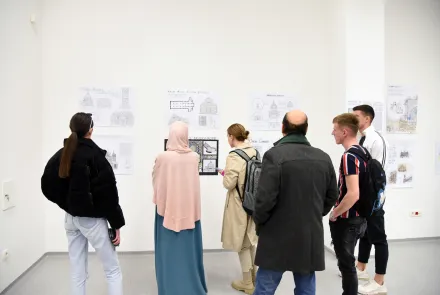
Earning a Bachelor's degree is one of the most important steps you can take towards increasing your earning potential and job opportunities.
The overall motive behind the Architecture Study Program is to address the strong student demands both within Bosnia and Herzegovina, the Balkans and Turkey. Architecture is a very popular profession in many countries around the globe. The increasing urbanization and the emergence of new technologies (i.e. sustainable design and digital technologies) require the establishment of new kind of built environment and the necessity to apply new approaches in architectural practice.
Considering this high demand and as an international higher education institute, IUS aims to extend its high quality higher education to canvass the field of architecture.
The overall aim of the Architecture Program is to establish a strong foundation for architectural practice and to provide opportunities for our students in rapidly changing professional practice in accordance with their individual skills. Therefore, the Architecture Program aims to prepare its students to fulfill legal requirements to be registered as architect in relevant statutory and governmental bodies in Bosnia and Herzegovina, Turkey and most of other countries in all around the globe.
Graduates are well prepared for exciting careers in various design related fields, such as architectural practice, town planning, construction, project/construction management, property development, research and heritage conservation. Students have easy access to the professors for help and mentoring, well developed design studios, computer laboratories as well as sporting and cultural events.
Candidates who are citizens of foreign countries can submit preliminary application for admission before the official call is published by the University, so that they can obtain necessary residency permits and satisfy language requirements prior to the start of lectures at the University.
Encourage and develop students' ability to express, nurture, and refine their architectural design skills, creativity, and critical thinking necessary for professional and academic excellence.
Introduce students to the diverse fields within architecture and the built environment, fostering interdisciplinary awareness and the ability to integrate knowledge across related domains.
Equip students with communication skills — visual, verbal, and written — that are essential for effective professional interaction with clients, teams, institutions, and communities in architectural practice.
Develop students' technical and conceptual abilities to design and manage projects of various types and scales, encouraging adaptive and innovative solutions in a rapidly changing environment.
Raise professionals who demonstrate advanced knowledge, ethical responsibility, and leadership potential in architecture, preparing them for lifelong learning, research, and contribution to discipline and society.
Demonstrate knowledge of the history and theory of architecture.
Identify the fundamental principles of building construction, materials, and structures.
Identify the principles and components of building systems.
Demonstrate knowledge of urban planning and the role of architecture in shaping cities and public spaces.
Recognize various digital tools and technologies used in architectural practice.
Demonstrate knowledge of the basic principles of structural engineering, including load-bearing structures, force distribution, and material behaviour.
Show the key principles of sustainable architecture, including energy-efficient design, passive design strategies, and the use of renewable materials and technologies.
Produce technical drawings using both traditional and digital tools.
Apply creative, functional, and innovative design solutions to architectural problems.
Use knowledge of advanced technologies used in architectural practice.
Implement principles of sustainable design, passive energy strategies, resource-efficient materials and environmentally responsible solutions.
Incorporate relevant legal and regulatory frameworks to the design and construction processes.
Apply ethical principles and professional standards in all aspects of architectural practice.
Develop independently functional, innovative, and contextually relevant architectural solutions that address complex design challenges.
Demonstrate the knowledge and skills to develop detailed architectural documentation.
Analyse and solve architectural problems, considering technical, cultural, historical, environmental and social factors.
Evaluate and select appropriate construction techniques, materials, and systems based on site-specific conditions, cultural and historical context, environmental impact, and social needs.
Develop critical thinking and effective communication skills through verbal, visual and written means.
Develop the ability to work in multidisciplinary teams.
Take the next step towards a creative career in Architecture. Explore our admission requirements and start your journey in shaping the built environment.
View Admission Requirements

Students who are interested in obtaining a minor degree from our study programs can see the minor curricula:
At the beginning of the introduction of emergency measures caused by the COVID-19 pandemic, IUS was among the first universities to completely switch to online teaching.













International University of Sarajevo - The best private university in Bosnia and Herzegovina